


Bolivia’s COB Skips Talks as Blockades Expand Nationwide
Bolivia’s main labor confederation rejected government talks as protests over fuel subsidies intensified, with road blockades expanding across several regions.
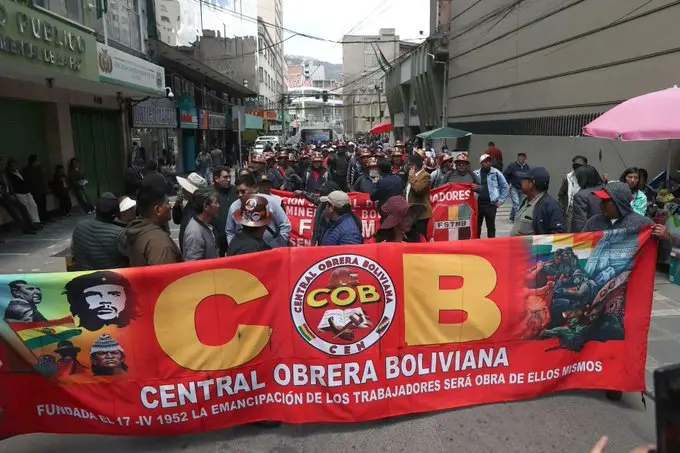
Campesino protesters block a highway with earth mounds and burning tires during nationwide demonstrations led by Bolivia’s Central Obrera Boliviana against Supreme Decree 5503. Photo: @teleSURtv
January 8, 2026 Hour: 4:05 am
🔗 Comparte este artículo
Bolivia’s Central Obrera Boliviana (COB) declined to attend a government-called dialogue on Tuesday amid escalating protests against Supreme Decree 5503, as road blockades spread across multiple regions of the country.
RELATED:
Bolivian Workers’ Central Announces National Blockade in Response to State Repression
The Ministry of Government confirmed that a meeting had been scheduled for 12:30 p.m. at its headquarters, with the participation of Economy Minister Gabriel Espinoza and Presidency Minister José Luis Lupo, following a request made earlier in the day by COB Executive Secretary Mario Argollo. However, union leaders did not appear. Government Minister Marco Antonio Oviedo questioned the absence, while the COB conditioned any dialogue on the release of those detained during clashes on Monday and reiterated its demand for the repeal of Decree 5503.
The labor confederation also announced an expansion of blockades nationwide and proposed drafting a new decree limited to fuel subsidies, improved social bonuses, and wage increases, leaving other provisions for debate in the Legislative Assembly.
Tensions increased after a police operation on Tuesday morning at the COB’s residence in northern La Paz. Police Deputy Commander Javier Salgueiro said the action was “a routine lodging check.” The COB raised concerns over the operation. Secretary General Eduardo Ferrufino said some leaders fled for fear of arrest, adding that Argollo was present at the site during the police intervention.
On Wednesday, campesino organizations aligned with the COB blocked major highways in rejection of the decree that removed fuel subsidies. Bolivia’s Road Administration (ABC) reported 19 blockade points, most of them in the department of La Paz. Members of the Tupac Katari Federation closed roads using earth mounds and burning tires, with affiliates standing directly on the roadways. “We regret this decree; we are on emergency footing and will go to the last consequences,” one leader told local media.
The ABC also reported road closures in Santa Cruz, Pando, and Potosí, where campesino groups remained on highways while intermittently allowing vehicles to pass. In La Paz, blockades linked to “social conflicts,” according to the ABC, were reported in Cruce Peñas on the Copacabana road, Achica Arriba, and Konani on the Oruro road. In Pando, blockade points were reported in Villa Rojas, Santa Elena, and Batrajas.
The protests have entered their 17th day, with actions concentrated mainly in western Bolivia after the COB decided to intensify measures from January 6. The confederation withdrew on Monday from talks proposed by the government and other social organizations aimed at easing tensions, insisting on the annulment of the decree.
Amid the ongoing unrest, the government announced it will suspend the application of Supreme Decree 5503 during a court hearing scheduled for Friday. The First Constitutional Chamber of the Santa Cruz Departmental Court admitted a legal challenge filed by a lawyer representing the COB, Presidency Minister José Luis Lupo told Unitel. “We will argue where appropriate; the government will respond to the popular action against the decree at the hearing on Friday at 13:00 (local time),” he said, confirming he will attend on behalf of the executive. “That is the path; institutions exist to address these claims, and there are different ways to reach solutions.”
COB leaders argue that Decree 5503 removes hydrocarbon subsidies and enables measures to accelerate national and foreign investment in natural resources, which they say directly affects workers’ purchasing power. They have warned that partial adjustments are insufficient and that failure to draft a new regulation could lead to further escalation, including a renewed nationwide and indefinite road stoppage.
Author: MK
Source: Prensa Latina - teleSUR